

Neanderthals May Have Become Infertile Due to Global Warming!
- Aug 18, 2024
- 4 min read
Another possibility is that the Neanderthal Y chromosome was incompatible with Modern Human African DNA! Following the successful sequencing of a significant amount of mtDNA, Svante Pääbo's team from the Max Planck Institute disclosed the initial full mitochondrial DNA (mtDNA) sequence for a Neanderthal (Green et al. 2008). The specimen originated from a 38,000-year-old Neanderthal found in Vindija Cave, Croatia. By examining the complete mtDNA sequence, researchers could compare the Neanderthal mtDNA with that of contemporary humans to determine if any modern humans possessed mtDNA from a lineage related to the Neanderthals. Now in 2024 we have the male Y Neanderthal chromosome to study!
After sequencing the genomes of female Neandertals for years, researchers have now obtained a clear view of a male Neandertal's Y chromosome, revealing it to be distinct from any Y chromosome in modern humans. Despite multiple interbreeding events between Neandertals and modern humans over the past 100,000 years, the Y chromosome DNA from a male Neandertal who lived 49,000 years ago in El Sidrón, Spain, has NOT been transmitted to modern humans, according to a report in The American Journal of Human Genetics. This aligns with previous studies showing that while Asians and Europeans have 1% to 3% of their DNA from Neandertals, their Y chromosomes lack Neandertal DNA. This absence suggests that there may have been reproductive incompatibilities between female modern humans and male Neandertals, possibly related to sperm production issues in the latter.
A team of scientists discovered that three Neanderthal genes located on the Y chromosome, different from those found in contemporary humans, are involved in the immune system. These genes are responsible for allowing the immune system to differentiate between the body's own cells and external entities. Failure to make this distinction accurately could lead to issues like tissue transplant rejection from male donors to female recipients or the mother's immune system attacking a male fetus, potentially resulting in miscarriage. This finding offers a possible explanation as to why all Europeans and Asians can trace their genetic ancestry roots back to about twelve individuals who were a mix of Neanderthals and modern humans and who survived into adulthood.
Around half a million years ago, Neanderthals separated from modern humans and developed outside of Africa. Meanwhile, the ancestors of Homo sapiens stayed in Africa until approximately 100,000 years ago, when they started to move to other regions. During this period, Neanderthals possessed distinctive adaptations that enabled them to thrive in cold climates, such as a unique biology with a blood chemical based on sulfur instead of selenium, particularly among individuals with European and Asian heritage.
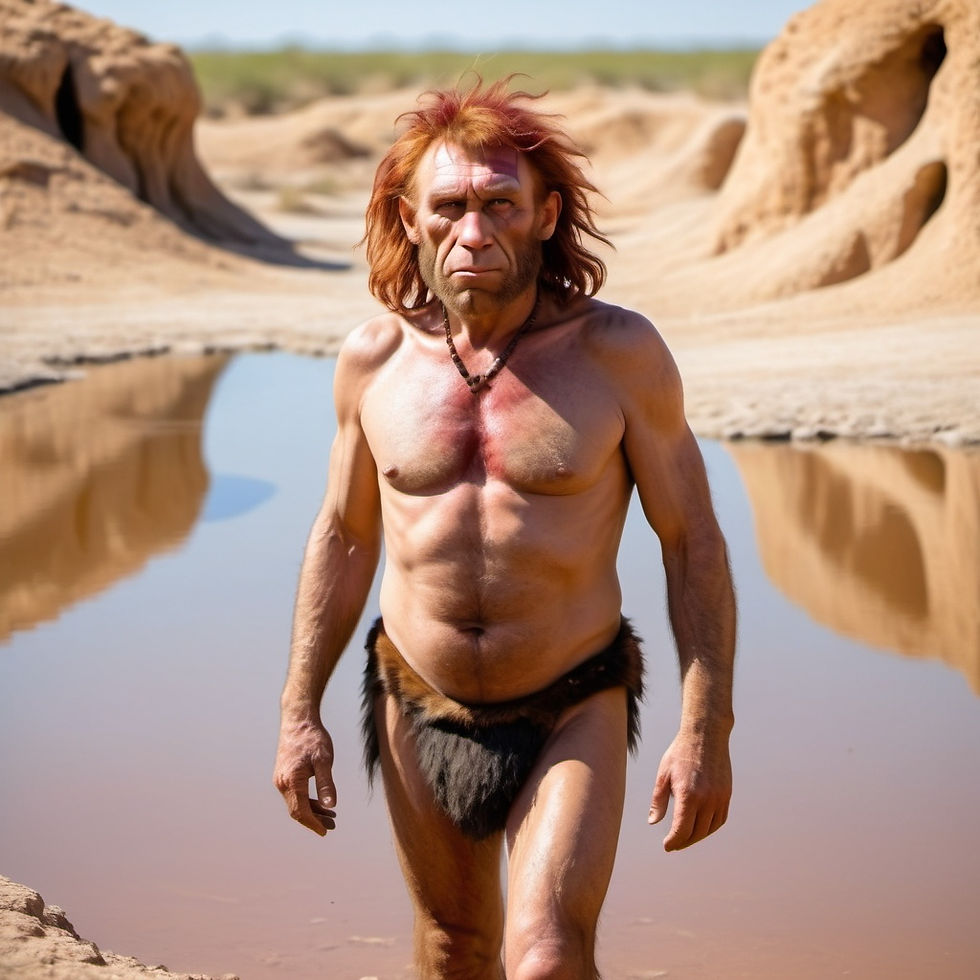
The substitution of sulfur with selenium to produce the amino acid selenocysteine is crucial for the production of selenoproteins, which were essential for survival in extreme cold conditions. Neanderthals possessed features such as short limbs, long red, blonde, and brown hair, and a sturdy torso that helped in conserving heat, along with wide long noses that facilitated warming and humidifying air during inhalation. Despite these physical distinctions, modern humans and Neanderthals share a close genetic relationship and exhibited similar appearances. There was even a period of coexistence, with both groups inhabiting the same regions simultaneously, notably in the Middle East and Europe. Given this proximity, the question arises: why did Neanderthals become extinct while modern humans thrived?
One of the Neanderthal genes, BNC2, is involved in skin pigmentation. That implies that Eurasians owe their paler skins partly to Neanderthals. Light skin is an advantage at higher latitudes because it is more efficient at generating vitamin D from sunlight, so Neanderthal DNA may have helped modern humans to adapt to life outside Africa.
“It is possible that Neanderthal DNA helped modern humans adapt to life outside Africa”
If so, the adaptation took thousands of years to become universal. A third study published this week describes a DNA analysis of one person who lived in Stone Age Europe about 7000 years ago – 40,000 years after any Neanderthal interbreeding. His genes suggest his skin was dark (Nature, doi.org/q74). It may be that the Neanderthal keratin affected early Eurasians’ hair instead, perhaps straightening it. Not all of the Neanderthal genes are beneficial. Sankararaman and Reich found that our Neanderthal inheritance includes several genes that make us susceptible to diseases including type 2 diabetes, lupus and Crohn’s disease.
Some of the genes, meanwhile, appear to have led to fertility problems. For instance, Sankararaman found that the X chromosome is almost devoid of Neanderthal DNA. This suggests that most Neanderthal DNA that wound up on the X chromosome made the bearer less fertile – a common occurrence when related but distinct species interbreed – and so it quickly disappeared from the human gene pool. “Neanderthal alleles were swept away,” says Sankararaman.
“This underlines that modern humans and Neanderthals are indeed different species,” says Fred Spoor of the Max Planck Institute for Evolutionary Anthropology in Leipzig, Germany. The genetic evidence further backs this up. Neanderthal DNA is irregularly spaced through the modern human genome rather than being fully mixed. That implies that interbreeding occurred very rarely. Sankararaman estimates it may have happened only four times. “But these relatively few matings obviously were an important event in the history of non-Africans,” says Reich.


Comments